Recall the recipe from Chapter 10 for building 𝐾 when equal masses
𝑚 are joined by springs. Start from the zero matrix. A spring of
stiffness 𝑘 joining masses 𝑖 and 𝑗 adds 𝑘/𝑚 to the diagonal
entries 𝐾𝑖𝑖 and 𝐾𝑗𝑗, and adds −𝑘/𝑚 to both 𝐾𝑖𝑗 and
𝐾𝑗𝑖. A spring joining mass 𝑖 to a fixed support adds 𝑘/𝑚 to
𝐾𝑖𝑖.
Two equal masses, each with 𝑚=1, are attached to fixed supports by
springs of stiffness 1. They are also joined to each other by a weak
spring of stiffness 𝜅, where 𝜅>0 is small. Their
displacements 𝑞1 and 𝑞2 satisfy 𝑞″=−𝐾𝑞.
(a)
Use the recipe to write down 𝐾. Find its eigenvalues
and eigenvectors, and the angular frequencies of the two modes. Explain
physically why the frequency of the mode in which the masses move
together does not depend on 𝜅.
(b)
Mass 1 is pulled to displacement 1 while mass 2 is held at 0,
and both are released from rest. Write the initial displacement as a
combination of the two mode shapes, and find 𝑞(𝑡).
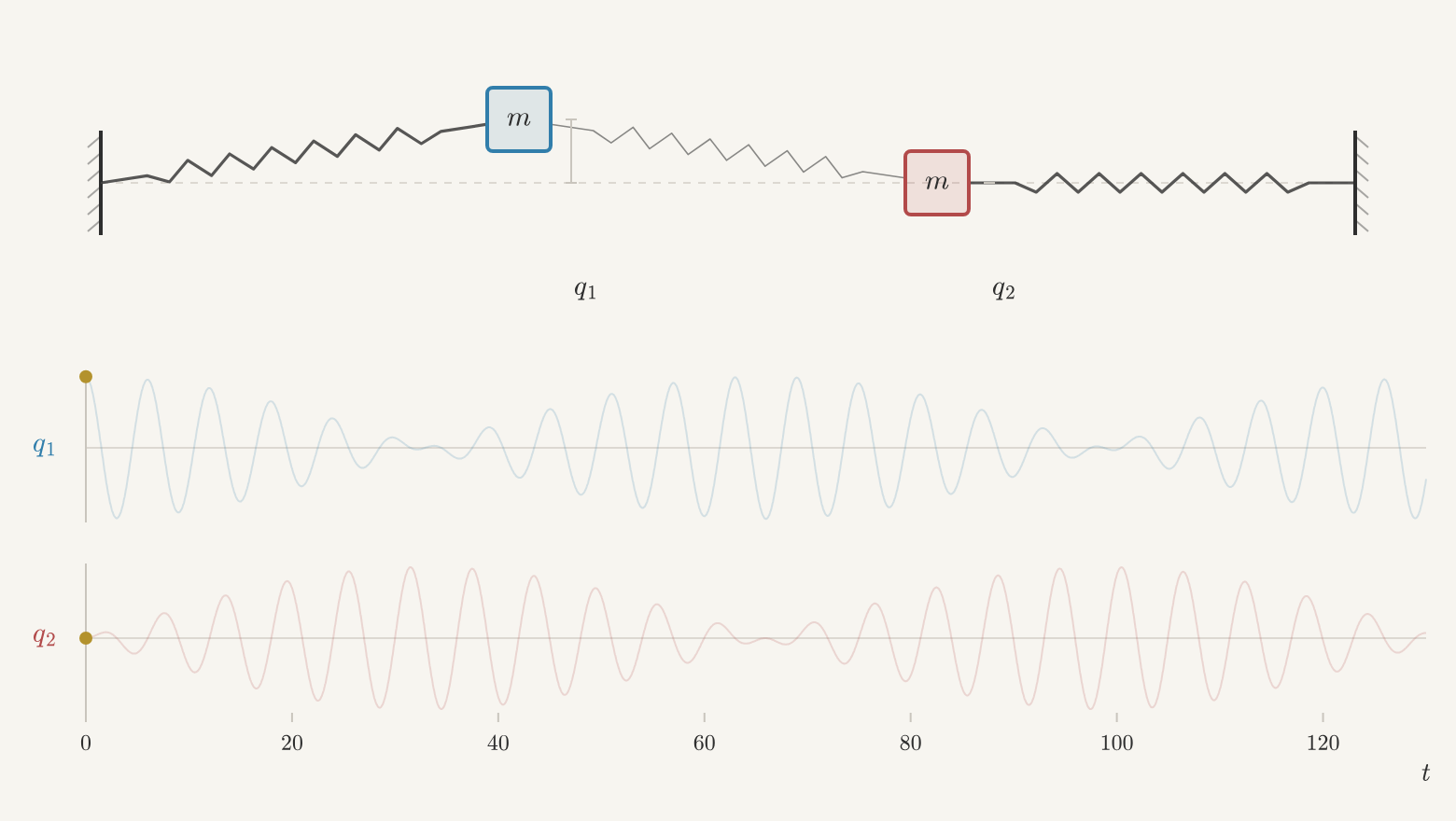
Figure 1 Mass 1 starts at displacement 1, mass 2 starts at 0, and both
start from rest. The thin middle spring is the weak one. Below, the
traces record 𝑞1 and 𝑞2 over time. Press Play to watch, and move
the slider to change 𝜅.
to write each displacement as a product of two oscillating factors.
When 𝜅 is small, which factor oscillates quickly and which
slowly? Find the first time 𝑇>0 at which the slow factor of 𝑞1 is
zero. What is mass 2 doing around that time?
(d)
Take 𝜅=0.1. Find 𝑇, and about how many swings mass 1 makes
before it hands its motion to mass 2. Then use the approximation
√1+2𝜅≈1+𝜅 for small 𝜅 to estimate 𝑇 in
terms of 𝜅. What happens to the transfer as the coupling gets
weaker? What happens when 𝜅=0?
2
Three equal masses, each with 𝑚=1, are attached to fixed supports by
springs of stiffness 1. Each pair of masses is also joined by a spring
of stiffness 1, so every mass is connected to both of the others.
Their displacements 𝑞1, 𝑞2, and 𝑞3 satisfy 𝑞″=−𝐾𝑞.
(a)
Use the recipe recalled in Problem 1 to write down 𝐾. Show that
(1,1,1) is an eigenvector of 𝐾, and find the angular frequency of
this mode. Explain physically why the springs joining the masses do not
affect this frequency.
(b)
Show that every vector 𝑣=(𝑎,𝑏,𝑐) with 𝑎+𝑏+𝑐=0 is an eigenvector of
𝐾, all with the same eigenvalue. Find two such mode shapes that are
orthogonal to each other. What are the angular frequencies of the
system?
(c)
The masses are at rest at equilibrium when mass 1 is struck, so that
𝑞(0)=⎛⎜
⎜
⎜⎝000⎞⎟
⎟
⎟⎠,𝑞′(0)=⎛⎜
⎜
⎜⎝100⎞⎟
⎟
⎟⎠.
Find 𝑞(𝑡).
(d)
Show that masses 2 and 3 move identically. Explain why we should
expect this from the arrangement of the springs. Does this motion ever
return exactly to its starting state? If so, after how long?
3
This problem compares the equilibria and periodic orbits of linear and
nonlinear equations.
(a)
Let 𝐴 be a 2×2 matrix, and suppose 𝑋0 is an equilibrium of
𝑋′=𝐴𝑋. Show that every multiple 𝑐𝑋0 is also an equilibrium.
Conclude that a linear system has either exactly one equilibrium or
infinitely many. Why does it always have at least one?
(b)
In one variable, a linear equation 𝑦′=𝑎𝑦 has either exactly one
equilibrium or every number as an equilibrium. A nonlinear equation
𝑦′=𝑓(𝑦) has much more freedom. Find a function 𝑓 for which the
equilibria of 𝑦′=𝑓(𝑦) are:
exactly five numbers;
exactly the integers;
(Optional challenge) exactly the numbers
0,1,12,13,14,… in the interval [0,1].
Extra challenge: can you find such an equation that also satisfies the
hypotheses of the existence and uniqueness theorem?
(c)
Let 𝐴 be a 2×2 matrix, and let 𝑋(𝑡) be a nonconstant periodic
solution of 𝑋′=𝐴𝑋 with period 𝑇, so that 𝑋(𝑡+𝑇)=𝑋(𝑡) for all 𝑡.
Show that the system has infinitely many periodic orbits. (Hint:
consider multiples 𝑐𝑋(𝑡). Show that they are solutions and that they
are periodic.)
4
Two species compete for the same resources. Their populations 𝑥 and
𝑦 satisfy
𝑥′=𝑥(3−2𝑥−𝑦),𝑦′=𝑦(2−𝑥−𝑦).
(a)
The nullclines are the curves where 𝑥′=0 or where 𝑦′=0. Find them,
and use them to find all four equilibria.
(b)
Compute the Jacobian matrix 𝐽(𝑥,𝑦). Evaluate it at the equilibrium
where both species are present, and classify that equilibrium. Do
populations that start near it move toward it or away from it?
5
In the system of Problem 4, suppose only species 𝑥 is present, at the
equilibrium (3/2,0), when a few individuals of species 𝑦 arrive.
Write the populations as 𝑥=3/2+𝑢 and 𝑦=𝑣, where 𝑢 and 𝑣 are
small.
(a)
Use the Jacobian at (3/2,0) to write the linear system that
approximately describes 𝑢 and 𝑣.
(b)
The equation for 𝑣 does not involve 𝑢. Solve it. Does the
population of species 𝑦 grow or die out?
6
A pendulum swinging without friction satisfies 𝜃″=−sin𝜃,
where 𝜃 is the angle from straight down.
(a)
Write this as a first-order system for 𝜃 and 𝜔=𝜃′.
Find all of its equilibria, and say what they mean for the pendulum.
(b)
Compute the Jacobian at (0,0) and at (𝜋,0). Show that near
(0,0) the linear system is the spring 𝑢″=−𝑢, where 𝑢 is the
small displacement of 𝜃 from the equilibrium. What second-order
equation do you get near (𝜋,0)? Classify both linear flows.