Work these on your own paper. Show enough of the reasoning that a reader
could follow it without you in the room.
1A loan, idealized
You take out a loan.
You make regular payments on the loan, but at the same time it is accumulating interest. Let's model this by a differential equation for the rate of change of your loan balance 𝐿(𝑡).
To write a differential equation we
think of the interest as compounding continuously at some rate, and of
your payments as flowing out continuously at the steady rate, rather than in monthly chunks.
(a)
Write a differential equation for the amount 𝐿(𝑡) you owe, in dollars,
with 𝑡 in years (define your own constants for interest and payment rates; and think about which one of these depends on the current size of the loan and which does not.)
Solution
Let 𝑟>0 be the annual interest rate (in inverse years) and 𝑝>0 the
payment rate (in dollars per year). Interest adds 𝑟𝐿 dollars per year,
while payments remove 𝑝:
𝐿′=𝑟𝐿−𝑝.
(b)
Without solving anything, read the sign of 𝐿′ from your equation: for
which loan amounts is the debt shrinking, and for which is it growing? What happens at the border in-between?
Solution
Since 𝑟>0, the debt shrinks when 0<𝐿<𝑝/𝑟 and grows when 𝐿>𝑝/𝑟.
At 𝐿=𝑝/𝑟, payments exactly cover the interest, so the balance stays
constant. The loan model stops when the debt reaches zero.
2The law of exponents, by uniqueness
Fix a number 𝑠, and consider the two functions
𝑓(𝑡)=𝑒𝑠+𝑡and𝑔(𝑡)=𝑒𝑠𝑒𝑡.
(a)
Verify that both functions solve 𝑦′=𝑦, and compute 𝑓(0) and 𝑔(0).
Solution
By the chain rule 𝑓′(𝑡)=𝑒𝑠+𝑡=𝑓(𝑡), and since 𝑒𝑠 is a constant,
𝑔′(𝑡)=𝑒𝑠𝑒𝑡=𝑔(𝑡). Both functions solve 𝑦′=𝑦, and
𝑓(0)=𝑒𝑠=𝑔(0).
(b)
Check that the hypotheses of the existence–uniqueness theorem hold at
every point.
Solution
Here 𝐹(𝑡,𝑦)=𝑦 and 𝜕𝐹/𝜕𝑦=1 are continuous everywhere,
so through each point there passes exactly one local solution.
(c)
What does the theorem now force? State the algebraic identity you have
just proved.
Solution
The two functions solve the same equation from the same initial value.
Uniqueness makes them agree throughout their common domain, which is all
of ℝ. Thus, for every 𝑠 and 𝑡,
𝑒𝑠+𝑡=𝑒𝑠𝑒𝑡.
(d)
Run the same argument again to prove the law of logarithms: for a fixed
𝑠>0, show that ln(𝑠𝑡) and ln𝑠+ln𝑡 solve the same
initial-value problem, and conclude that ln(𝑠𝑡)=ln𝑠+ln𝑡 for every
𝑡>0.
Solution
Both functions have derivative 1/𝑡 — the first by the chain rule,
𝑠/(𝑠𝑡)=1/𝑡 — so both solve 𝑦′=1/𝑡, whose right side and its
𝑦-derivative are continuous for 𝑡>0. At 𝑡=1 they agree:
ln(𝑠⋅1)=ln𝑠=ln𝑠+ln1. Two solutions of the same equation
with the same value at 𝑡=1 must coincide, so ln(𝑠𝑡)=ln𝑠+ln𝑡
for every 𝑡>0.
3Drawing a slope field
Consider the equation
𝑦′=𝑦2−𝑡.
(a)
Find every point where the equation prescribes slope zero, and describe
this set of points as a curve in the (𝑡,𝑦)-plane.
Solution
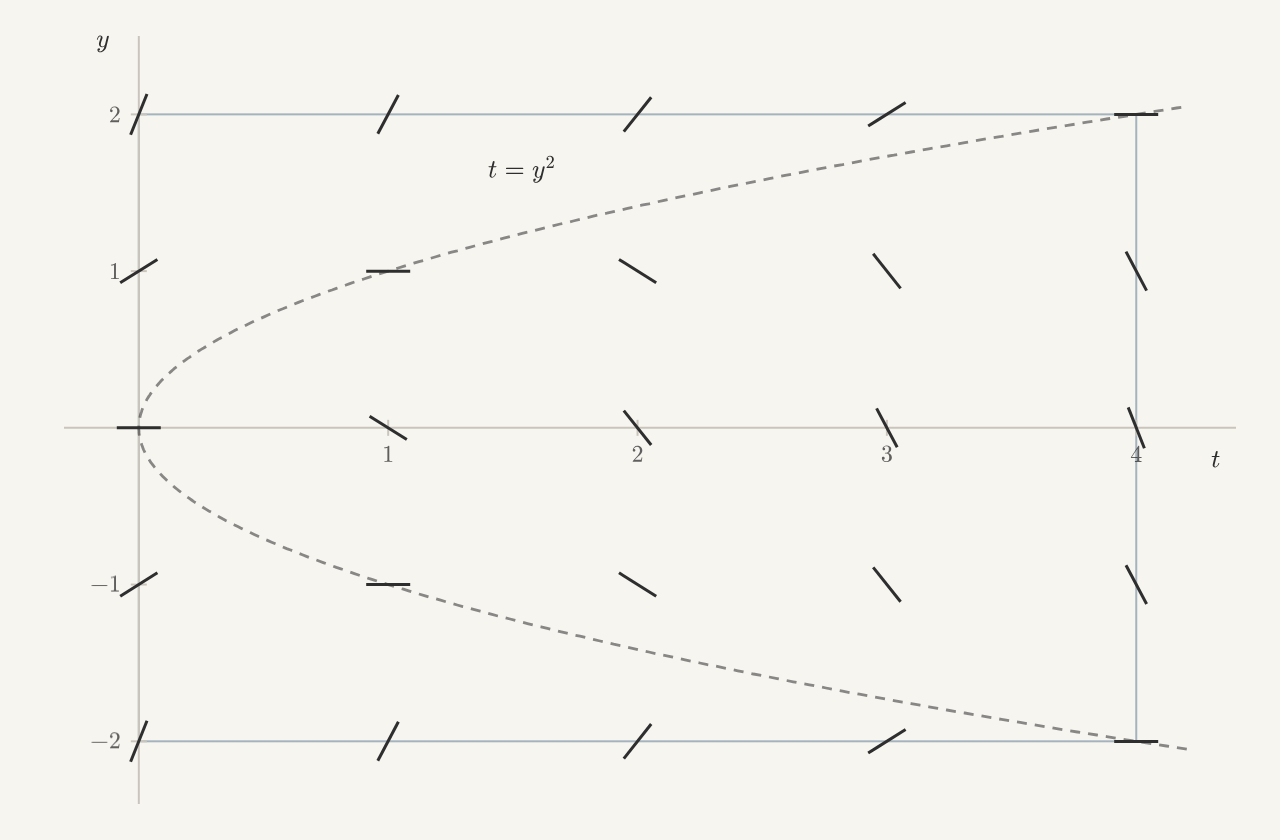
The slope is zero exactly when 𝑡=𝑦2: a parabola through the origin,
opening in the positive 𝑡 direction.
(b)
On the region 0≤𝑡≤4, −2≤𝑦≤2, compute the prescribed slope
at each integer grid point and sketch the slope field. Your curve from the
previous part organizes the picture: which side of it has rising ticks,
and which falling?
Solution
The slope at each grid point is 𝑦2−𝑡:
𝑦\𝑡
0
1
2
3
4
2
4
3
2
1
0
1
1
0
−1
−2
−3
0
0
−1
−2
−3
−4
−1
1
0
−1
−2
−3
−2
4
3
2
1
0
Figure 1 The slope field at the integer grid points. The dashed parabola 𝑡=𝑦2
marks slope zero.
Ticks rise to the left of the parabola (𝑡<𝑦2), fall to its right
(𝑡>𝑦2), and are horizontal on it.
(c)
Into your field, sketch the solutions starting from 𝑦(0)=2 and from
𝑦(0)=0. Describe in a sentence or two how their fates differ.
Solution
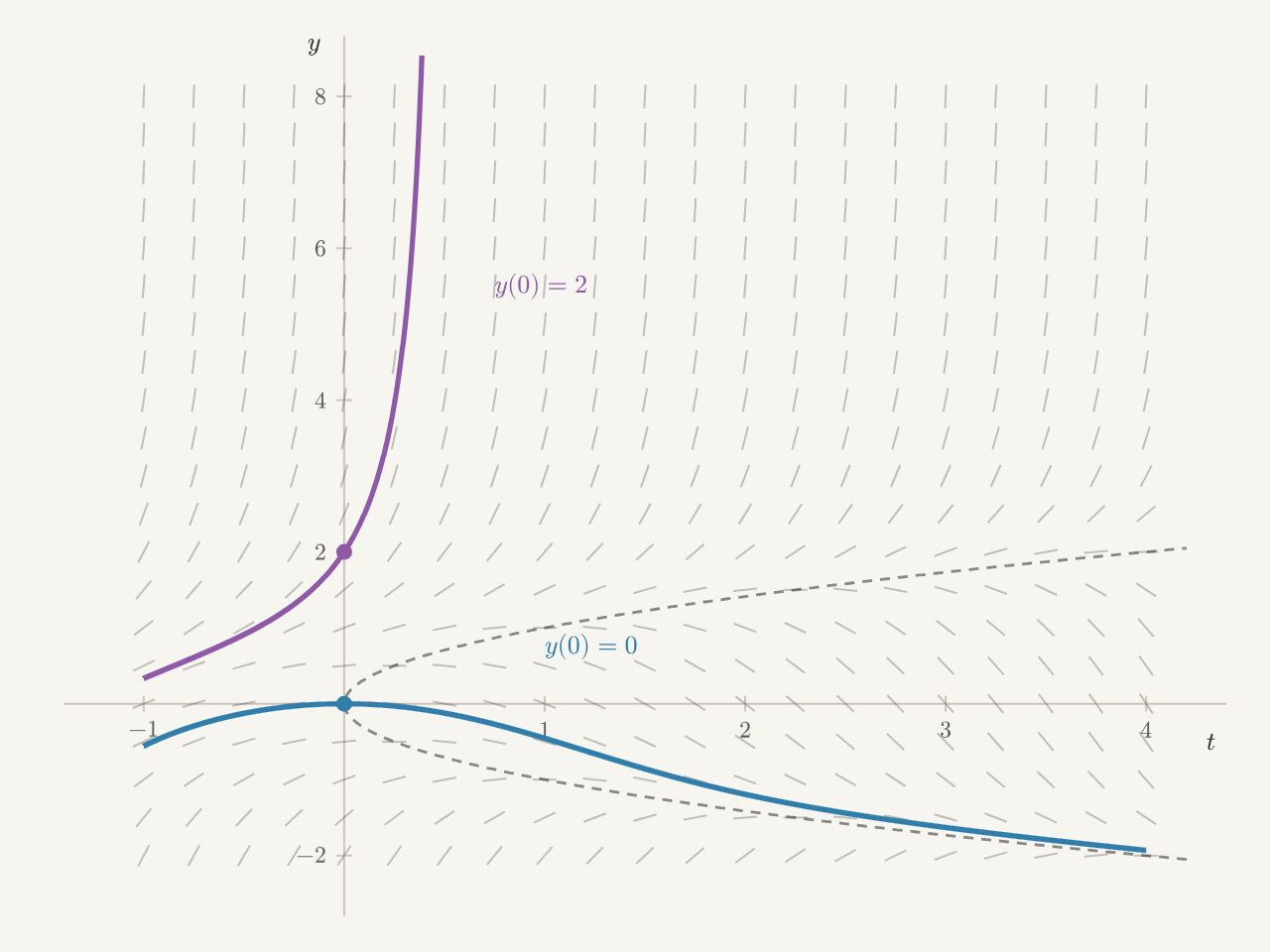
The solution from 𝑦(0)=2 begins with slope 4 and climbs ever more
steeply. The solution
from 𝑦(0)=0 begins flat, then decreases above the lower branch
𝑦=−√𝑡; numerically, 𝑦(4)≈−1.931. It follows that branch
without lying on it: zero-slope points form a guide, not a solution curve.
Figure 2 A wider view with a denser slope field and the two numerically computed
solutions. The marked points are (0,0) and (0,2); the dashed parabola
is 𝑡=𝑦2.
4Solutions and impostors
In each part, decide whether the proposed function solves the
differential equation. Explain your reasoning.
(a)
The equation 𝑦′=𝑦+𝑒𝑡, with the two candidates 𝑦=𝑡𝑒𝑡 and 𝑦=2𝑒𝑡.
Solution
For 𝑦=𝑡𝑒𝑡, the product rule gives
𝑦′=𝑒𝑡+𝑡𝑒𝑡=𝑦+𝑒𝑡,
so it is a solution. For 𝑦=2𝑒𝑡, the left side is 𝑦′=2𝑒𝑡 while the
equation demands 𝑦+𝑒𝑡=3𝑒𝑡. These are never equal, so 2𝑒𝑡 is not a
solution.
(b)
The system 𝑓′=𝑓+𝑔, 𝑔′=𝑔−𝑓, with the two candidate pairs
𝑓=𝑒𝑡cos𝑡, 𝑔=−𝑒𝑡sin𝑡 and 𝑓=𝑒𝑡, 𝑔=0.
Solution
For the first pair, the product rule gives
𝑓′=𝑒𝑡cos𝑡−𝑒𝑡sin𝑡=𝑓+𝑔,𝑔′=−𝑒𝑡sin𝑡−𝑒𝑡cos𝑡=𝑔−𝑓,
so the pair solves both equations. The pair 𝑓=𝑒𝑡, 𝑔=0 satisfies the
first equation, since 𝑓′=𝑒𝑡=𝑓+𝑔, but fails the second: 𝑔′=0, while
the equation demands 𝑔−𝑓=−𝑒𝑡. A pair must satisfy both equations, so
this pair is not a solution.
5Autonomous or not
Consider the three rules
(i)𝑦′=𝑦2−4,(ii)𝑦′=𝑦+𝑡,(iii)𝑓′=𝑓+𝑔,𝑔′=𝑔−𝑓.
(a)
Which of these are autonomous? Answer with a sentence each.
Solution
Rules (i) and (iii) are autonomous: their instructions depend only on the
current state, not on the time. Rule (ii) is not — the slope it
prescribes changes with 𝑡 even when 𝑦 stays the same.
(b)
For rule (ii): show that the state 𝑦=0 receives different instructions
at two different times. Explain why this makes a phase line for (ii)
impossible.
Solution
At 𝑦=0 the prescribed slope is 0+𝑡=𝑡: zero at 𝑡=0, and 2 at
𝑡=2. A phase line has one point for the state 𝑦=0, and that single
point cannot carry both instructions at once. Only when the rule ignores
the clock can the time direction be projected away.
6A phase line
Consider the autonomous equation
𝑦′=𝑦2−4.
(a)
Find every value of 𝑦 where the equation prescribes no motion, and draw
the phase line, with arrows determined by the sign of 𝑦2−4.
Solution
The rule vanishes at 𝑦=±2: two resting states. For 𝑦<−2 the sign
of 𝑦2−4 is positive, so the arrows point upward toward −2; for
−2<𝑦<2 it is negative, so the arrows point downward toward −2; for
𝑦>2 it is positive, and the arrows point upward, away from 2.
↑∘2↓∙−2↑
(b)
Using only your phase line, describe the entire future of the solution
starting at 𝑦(0)=0, and of the solution starting at 𝑦(0)=3.
Solution
From 𝑦(0)=0 the arrows point downward: the solution decreases,
approaching the resting value −2 but never arriving — reaching it
would put two solutions through the same point, which uniqueness
forbids. It stays between −2 and 0 and exists for every future time.
From 𝑦(0)=3, the solution increases without bound: it cannot settle at
a finite value where 𝑦2−4 is still positive. The phase line alone does
not tell us whether this happens in finite or infinite time.
7Choosing the right guess
(a)
Consider 𝑡2𝑦″=2𝑦. First try the guess 𝑦=𝑒𝑟𝑡 and explain why
no value of 𝑟 can ever work. Then try a power, 𝑦=𝑡𝑛: find every
value of 𝑛 that works, and verify the resulting solutions by
substitution.
Solution
Substituting 𝑦=𝑒𝑟𝑡 gives
𝑡2𝑟2𝑒𝑟𝑡=2𝑒𝑟𝑡,
which would require 𝑡2𝑟2=2 at every time 𝑡. No fixed 𝑟 can
manage that: for 𝑟≠0 the left side varies with 𝑡, and for 𝑟=0
it is zero.
Substituting 𝑦=𝑡𝑛 instead gives
𝑡2𝑛(𝑛−1)𝑡𝑛−2=𝑛(𝑛−1)𝑡𝑛=2𝑡𝑛,
so 𝑛(𝑛−1)=2, i.e. 𝑛2−𝑛−2=(𝑛−2)(𝑛+1)=0: the powers 𝑛=2 and
𝑛=−1. Directly, 𝑡2(𝑡2)″=2𝑡2 and 𝑡2(1/𝑡)″=𝑡2⋅2/𝑡3=2/𝑡,
so 𝑦=𝑡2 solves everywhere and 𝑦=1/𝑡 solves away from 𝑡=0.
(b)
Consider 𝑦′+𝑦=𝑒2𝑡. Here an exponential is clearly the right shape —
but with a knob: try 𝑦=𝐴𝑒2𝑡, and find the value of 𝐴 that makes
it a solution.
Solution
Substituting gives
2𝐴𝑒2𝑡+𝐴𝑒2𝑡=3𝐴𝑒2𝑡=𝑒2𝑡,
so the guess works exactly when 𝐴=13: the solution
𝑦=13𝑒2𝑡.
8Separating variables
Solve each initial-value problem. State its domain: the largest interval
containing the initial time on which it solves the differential equation
(be careful about division by zero, logarithms of negative numbers, etc.).
(a)
𝑦′=−𝑡𝑦, 𝑦(0)=2.
Solution
No constant function solves this equation, so there are no equilibria to
find. Separating,
𝑦𝑑𝑦=−𝑡𝑑𝑡⟹𝑦22=−𝑡22+𝐶,
so 𝑡2+𝑦2 is constant: the solution curves are arcs of circles. The
initial condition gives 𝑡2+𝑦2=4, and since 𝑦(0)=2>0 we take the
upper branch:
𝑦=√4−𝑡2.
The largest interval containing 0 is (−2,2); at its endpoints the
solution reaches 𝑦=0, where the equation itself breaks down.
(b)
𝑦′=𝑡𝑦+𝑡, 𝑦(0)=0.
Solution
Factoring the right side as 𝑡(𝑦+1) shows the constant function
𝑦≡−1 is an equilibrium solution. Our initial condition is not
−1, so we may divide:
𝑑𝑦𝑦+1=𝑡𝑑𝑡⟹ln|𝑦+1|=𝑡22+𝐶,
so 𝑦+1=𝐴𝑒𝑡2/2. The initial condition gives 𝐴=1, and
𝑦=−1+𝑒𝑡2/2,
defined for all time.
(c)
𝑦′=𝑒𝑡+𝑦, 𝑦(0)=0.
Solution
The right side splits: 𝑒𝑡+𝑦=𝑒𝑡𝑒𝑦, which is never zero, so there
are no equilibria. Separating,
𝑒−𝑦𝑑𝑦=𝑒𝑡𝑑𝑡⟹−𝑒−𝑦=𝑒𝑡+𝐶,
so 𝑒−𝑦=𝐴−𝑒𝑡. The initial condition gives 𝐴=2, and
𝑦=−ln(2−𝑒𝑡).
This is defined only while 𝑒𝑡<2: the largest interval containing 0
is (−∞,ln2), and 𝑦→∞ as 𝑡→ln2 from below.